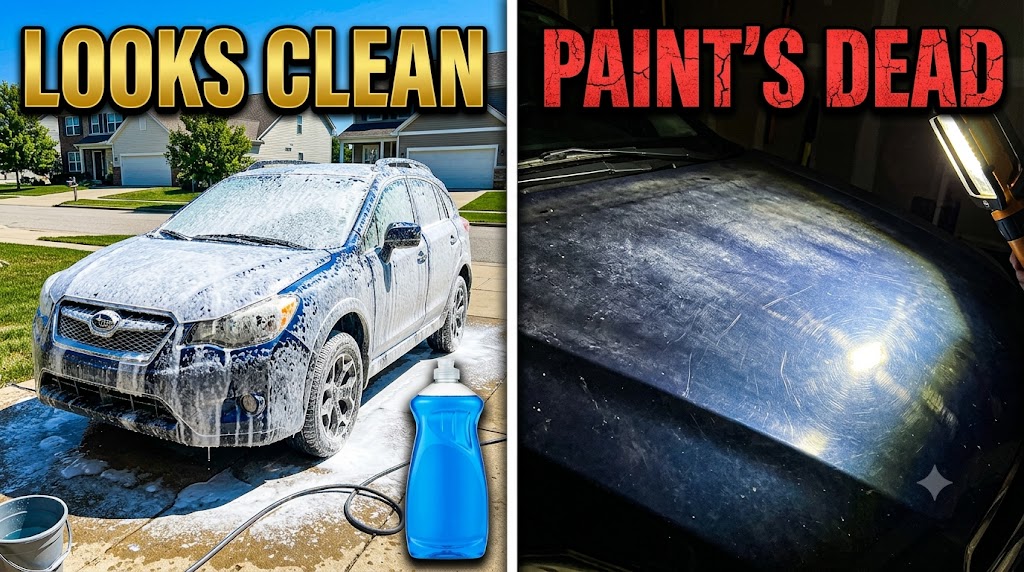
"Just grab the Dawn from under the sink" might be the most common car wash advice ever handed down from dad to kid. And the logic seems airtight: if it cuts grease on a frying pan, it'll cut road grime on a fender. There's no shortage of TikTok videos showing a satisfying before-and-after to back it up. Here's the problem — that exact logic is why dish soap slowly ruins your paint.
Dish soap is engineered to do one thing exceptionally well: remove every trace of grease and oil from a surface, leaving nothing behind. On a pan, that's the whole point. On your car, the "grease" it strips away includes the wax or sealant protecting your paint — and dish soap can't tell the difference between cooking oil and carnauba.
Why your car "looks" cleaner after a dish soap wash
This part is real, and it's what keeps the myth alive. The first wash with dish soap often makes the paint look sharper. With no wax or sealant sitting on top, light reflects straight off the clear coat, and the finish reads as "extra clean." The bill comes due later. With the protective layer gone, your paint is directly exposed to UV rays, acid rain, bird droppings, and road grime. Park that car outside in Arizona or Florida sun for a few weeks and you'll watch the gloss fade and oxidation set in faster than it ever did before — the exact opposite of what you were going for.
What dish soap actually does to automotive paint
The one time dish soap is actually the right call
Here's the twist most videos leave out: professional detailers do use dish soap — on purpose, exactly once. When you're about to polish a car or lay down a fresh coat of wax or sealant, you want every trace of the old protection gone so the new product bonds directly to the paint. That's called a strip wash, and dish soap is a cheap way to do it. The difference is what happens next. A detailer strips the wax and replaces it the same afternoon. The driveway version strips the wax and replaces it with nothing.
Already been washing with dish soap? Here's how to check the damage
There's a thirty-second test. Spray some water on the hood and watch what it does. If it beads up into tight little drops, you still have wax or sealant on the paint. If it sheets out flat and just sits there, the protection is gone — and if you've been reaching for the dish soap every weekend, flat is what you'll see. The good news is that stripped wax isn't permanent damage by itself. Wash the car properly, apply a coat of wax or a spray sealant, and you're protected again. A decent spray wax costs $10 to $20 and takes fifteen minutes to apply. What you can't undo is oxidation that already set in from months of bare paint baking in the sun. That takes polishing to fix, and every polish removes a little clear coat you never get back.
What to use instead
A dedicated pH-neutral car wash soap runs about $8 to $15 at any auto parts store, and a single bottle lasts for dozens of washes — you're using an ounce or two per bucket. The difference isn't the price, it's the formulation. It lifts dirt without touching the wax underneath, and plenty of "wash and wax" versions actually deposit a thin layer of protection with every wash. That's the real reason a well-kept car stays glossy for months without constant polishing: the wash itself never undoes the protection.
If you take one thing from this: dish soap doesn't damage paint in one dramatic moment. It just quietly removes the bodyguard, then lets the sun do the damage for it. Spend the ten bucks on real car soap. Your clear coat will outlast the myth.
Free tool: Tire Size Calculator
Thinking about new wheels or tires? Compare any two tire sizes and see the real difference in diameter, speedometer error, and fitment — instantly.
Open the calculator →