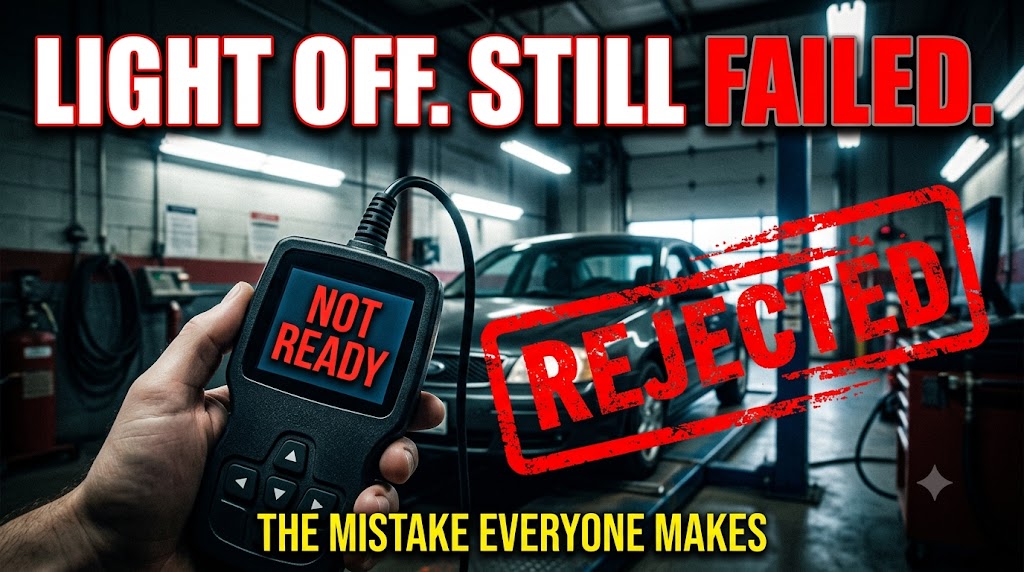
Here's a scenario that plays out at inspection stations every single day. A driver notices the check engine light a week before the test. They borrow a code reader, clear the code, and the light goes off. Problem solved, they figure. They drive to the station confident, and they get rejected anyway.
The frustrating part is that clearing the code is exactly what caused the failure. Not the original fault. The clearing.
How the test actually works
Every US passenger vehicle from model year 1996 onward has OBD-II, the standardized onboard diagnostics system. In states that run an emissions inspection, the test is largely a conversation with that computer rather than a tailpipe measurement. The Clean Air Act requires inspection and maintenance programs to check the OBD system, and the inspector reads what your car reports.
Your car reports two separate things. First, whether the malfunction indicator lamp is commanded on. An illuminated check engine light is an automatic failure, no discussion. Second, and this is the part that catches people, whether the readiness monitors have completed.
Readiness monitors are self-tests your car's computer runs on individual emissions systems: the catalytic converter, the oxygen sensors, the evaporative system, the EGR, and others. Each one needs specific driving conditions to complete. When you clear codes or disconnect the battery, the computer wipes those stored results along with the codes. The light goes off, but every monitor resets to "not ready."
The inspector plugs in and sees a car that can't demonstrate its emissions systems are working. That's a rejection. The inspector can't override it, because the vehicle itself is refusing to certify.
The mistakes that guarantee a rejection
What to do instead
If the check engine light is on, get the actual fault diagnosed and repaired, then give the car one to two weeks of ordinary mixed driving before the test. Highway miles plus some stop-and-go tends to complete monitors faster than short trips alone. A basic OBD-II scanner, which runs $20 to $40, will show you monitor status directly, so you can confirm the car is ready before you spend money on a test appointment.
If your battery died or you had electrical work done recently, treat that the same way. Drive it for a couple of weeks before scheduling.
The rules are moving, and not in one direction
Requirements vary heavily by state, and several changed recently. A quick snapshot as of July 2026:
California. The Bureau of Automotive Repair adopted new OBD-II regulations effective October 1, 2025 requiring all readiness monitors to be set, replacing an older rule that allowed the evaporative monitor to be unset on 2000 and newer gasoline vehicles. BAR has described the implementation as phased and data-driven.
Texas. HB 3297 eliminated the annual safety inspection for non-commercial vehicles effective January 1, 2025, but drivers still pay a $7.50 inspection program replacement fee at registration. Emissions testing was not eliminated. It covers 17 counties, and Bexar County (San Antonio) is scheduled to be added on November 1, 2026.
New Hampshire. The state's repeal of its inspection program, scheduled for January 31, 2026, was blocked by a federal preliminary injunction on January 27, 2026, on the grounds that the state needed EPA approval first. This one is live litigation, so confirm the current status with the NH Department of Safety before assuming either way.
North Carolina. On May 8, 2026, the EPA proposed approving the state's request to remove its vehicle inspection and maintenance program from its State Implementation Plan for the remaining 19 counties.
The one constant underneath all of it is federal: a state can't simply drop an emissions program on its own, because removing it from the State Implementation Plan requires EPA approval. That's the mechanism that stopped New Hampshire and that North Carolina is working through.
Whatever your state does, the readiness-monitor trap doesn't change. Fix the fault, then drive the car. There's no shortcut that beats the computer, because the computer is the one being asked.
Free tool: Oil Change Interval Calculator
The 3,000-mile rule is long dead. See your real interval based on your oil type and how you actually drive.
Open the calculator →