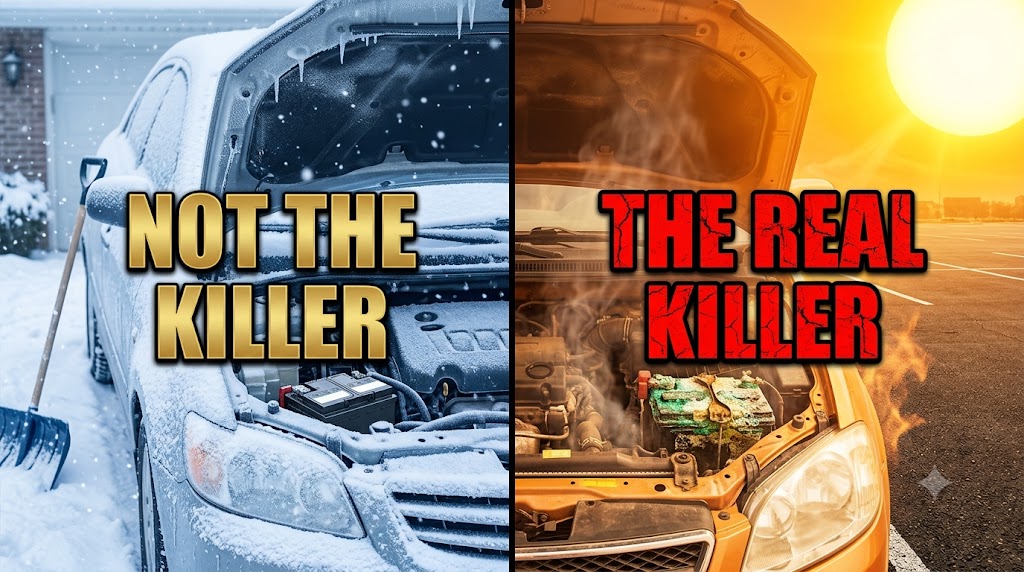
Ask any driver what kills car batteries and you'll get the same answer almost every time: winter. It makes intuitive sense. We've all heard the stories — or lived them — of a car that cranks slow and dies on the first frigid morning of the year. But here's what the battery industry has known for decades: the cold morning is when the battery dies, not why it died. The real killer did its work months earlier, in July and August.
Cold weather does reduce a battery's cranking power, but that effect is temporary. Heat is different. Extreme heat corrodes the battery from the inside — slowly, permanently, every single hot day of summer. Winter just delivers the verdict.
What heat actually does inside your battery
A standard car battery works through a chemical reaction between lead plates and a liquid electrolyte. Heat accelerates chemical reactions — basic physics — and that applies inside your battery too. When temperatures under the hood climb, that internal reaction runs faster than it was designed to. Part of the electrolyte evaporates, and the lead plates corrode at an accelerated rate. Industry testing and warnings from organizations like AAA point to the same rough rule: for roughly every 15°F above the ideal operating temperature (around 77°F), battery life can be cut in half.
And the numbers under your hood are brutal. On a 95°F day, the engine bay can easily push past 140°F, and a car parked in direct sun becomes an oven even with the engine off. That's why a battery that sits baking in a driveway all summer ages far faster than expected — with zero visible symptoms until the morning it simply refuses to start.
The proof is on the map. In hot-climate states like Arizona, Texas, Nevada, and Florida, batteries routinely last only two to three years. In the northern states everyone assumes are hardest on batteries, four to five years is common. If cold were the real killer, that pattern would run the other way.
How to protect your battery from the heat
The warning signs most drivers miss
Heat damage rarely announces itself, but it does leave clues. A slower crank than usual, especially after the car has been sitting in the sun all afternoon. Headlights that dim slightly at idle and brighten when you rev. Electronics that act glitchy for a second right at startup. A rotten-egg smell near the battery is a more serious sign — that's the electrolyte overheating, and it means the battery is already on its way out.
The physical check takes thirty seconds. Pop the hood and look at the battery case itself. A case that looks swollen or bulged on the sides is a classic heat casualty: the internal components have warped, and no amount of charging brings that back. Same with heavy white or blue-green crust on the terminals midway through summer. Any of these signs on a battery past its third birthday means it's time to plan the replacement on your schedule, not the battery's.
Why summer is the season to pay attention
Here's the part that trips people up: heat damage and cold failure are two chapters of the same story. Summer heat quietly eats away at the battery's internal capacity. Then the first cold snap arrives, demands maximum cranking power, and the weakened battery can't deliver. The driver blames the cold. The cold just collected on a debt the heat ran up months before.
So if your battery is three years old or more and it just survived a brutal summer, don't wait for the failure. Most auto parts stores will load-test your battery for free in a few minutes. Five minutes in the parking lot beats a no-start in your driveway — or worse, somewhere far from home.
Free tool: Tire Size Calculator
Thinking about new wheels or tires? Compare any two tire sizes and see the real difference in diameter, speedometer error, and fitment — instantly.
Open the calculator →