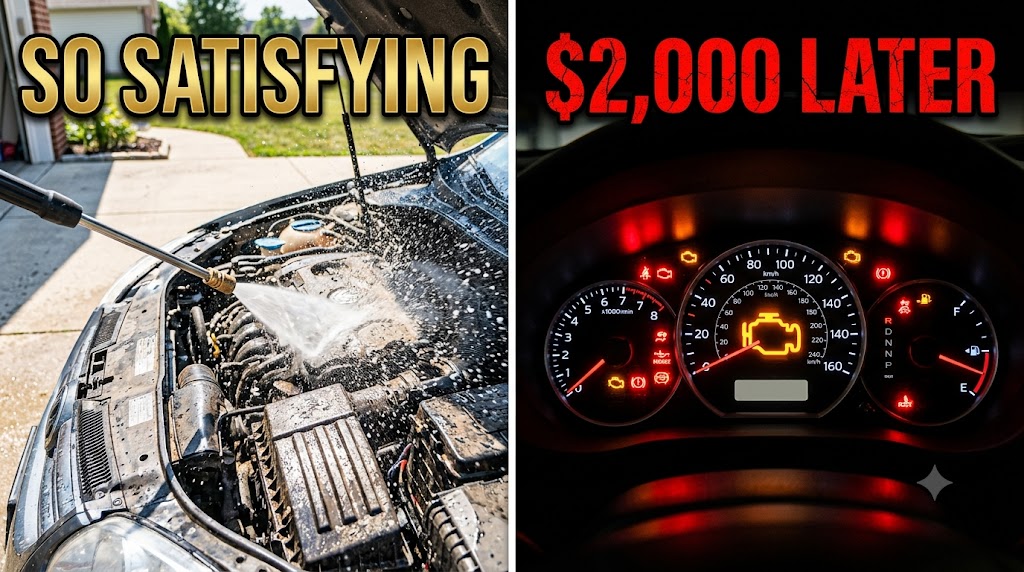
You've seen it done. A car rolls into a quick-wash bay, someone pops the hood, and the pressure washer goes straight into the engine compartment at full blast. Two minutes later everything is dripping and shiny, the customer drives off happy, and it looks like a great deal. Some shops do this all day, every day.
Here's the problem: the automakers themselves say don't do it. Ford, Chevrolet, Toyota and Volkswagen all put explicit warnings in their owner's manuals against spraying pressurized water into the engine bay. That's not engineers being overly cautious. It's them trying to save you from a repair bill that can easily run into four figures — far more than any wash was ever worth.
So is it safe to pressure wash your engine bay? The short answer is no, not the way most people do it. The longer answer is that engine bay cleaning is absolutely doable — you just have to swap the pressure washer for a method that respects what's actually under the hood.
What a pressure washer does to an engine bay
Why the shiny result is misleading
The frustrating part is that the pressure-washed engine bay looks great immediately afterward. That's exactly why the practice survives. The damage is invisible: water sitting inside a connector, a hairline crack in a plastic housing, moisture wicking up a wiring harness. Modern cars make it worse — a vehicle from the last fifteen years can have dozens of sensors, modules, and connectors packed under the hood, and a single flooded ECU can cost $1,000 or more to replace. On some vehicles, water intrusion in the wrong module has effectively totaled the car's electronics.
The safe way to clean an engine bay
The method professional detailers use is simpler than you'd think, and it doesn't involve high pressure at all. Start with a completely cool engine — park it overnight or wait at least a few hours. Cover the alternator, the fuse box, and any exposed connectors or air intake with plastic bags. Then spray a dedicated engine degreaser (a good one runs $8–15 at any auto parts store) onto the grimy areas, let it dwell for a few minutes, and agitate stubborn spots with a soft detailing brush.
For the rinse, less is more. A garden hose on a gentle shower setting, or even just damp microfiber towels, is enough to lift the loosened grime. Never aim water directly at electrical components, and keep it away from the fuse box entirely. Wipe everything down, let the bay air-dry with the hood open, then remove the plastic covers. If you want that clean look to last, a water-based trim dressing on the plastic covers finishes the job for another $10.
Yes, it takes longer than two minutes with a pressure washer. Call it 45 minutes start to finish. But nothing under the hood is put at risk, and you only need to do it two or three times a year. The rule from anyone who's detailed cars for a living: the engine bay gets cleaned with chemistry and patience, not with pressure. Save the pressure washer for the wheels.
Free tool: Tire Size Calculator
Thinking about new wheels or tires? Compare any two tire sizes and see the real difference in diameter, speedometer error, and fitment — instantly.
Open the calculator →