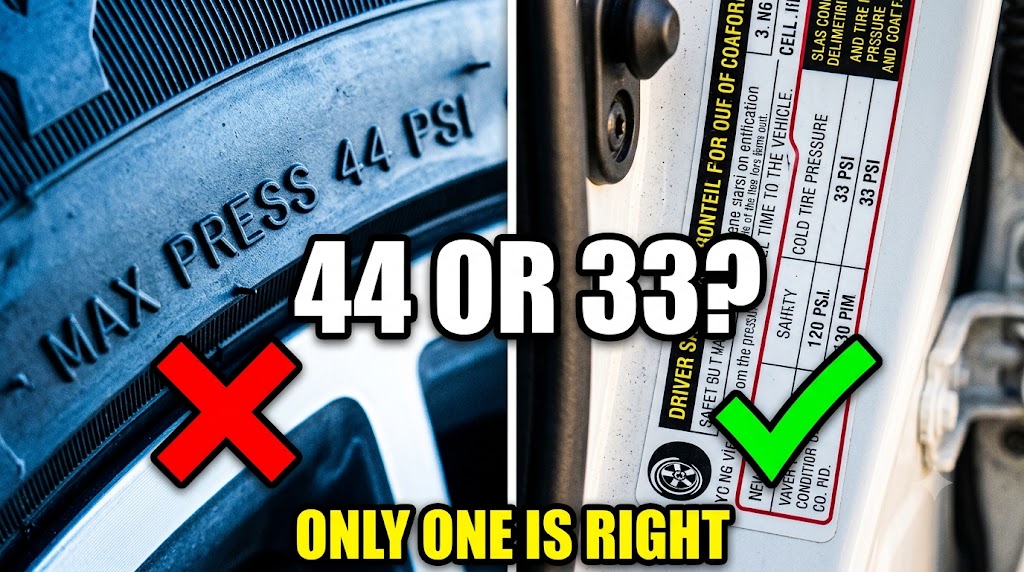
There's a number molded right into the rubber of your tire. It says something like MAX PRESS 44 PSI. It's printed on the product itself, in raised letters, which makes it feel authoritative in a way a sticker never could. Millions of American drivers inflate to that number, and plenty of quick-lube techs top them off to it.
It's the wrong number. Not slightly wrong. It's answering a completely different question than the one you're asking.
What that sidewall number actually means
The sidewall figure is a structural ceiling for the tire as a standalone component. It's the maximum pressure that particular tire is rated to hold, independent of what vehicle it ends up on. It says nothing about your car's weight, suspension geometry, or how the engineers balanced ride, braking and load capacity.
The number that answers your question is on the placard in your driver's door jamb, and in your owner's manual. That's the vehicle manufacturer's recommended cold inflation pressure, calculated specifically for your car. Federal safety standard FMVSS No. 110 requires that placard to exist, and requires the placard pressure to be equal to or lower than the tire's maximum sidewall pressure. They are, by regulation, two different things.
The US Department of Energy says this outright on FuelEconomy.gov: use the pressure on the door jamb sticker or in the owner's manual, and do not use the maximum pressure printed on the tire's sidewall. The gap is usually substantial. A common tire stamped 44 PSI often sits on a car spec'd at 33 to 35 PSI.
Why over-inflating to the max is a bad trade
Running near the sidewall maximum won't blow your tire up on the way to work. What it does is shrink the contact patch, harden the ride, wear out the center of the tread ahead of the shoulders, reduce wet-weather traction, and make the tire more vulnerable to pothole and impact damage. You're trading away grip and tread life for a firmer ride and a marginal fuel-economy gain.
The more common problem: almost nobody checks correctly
The safety and cost math
NHTSA crash-data analysis found that vehicles with tires underinflated by 25% or more were about three times more likely to be involved in a tire-related crash than properly inflated vehicles. And a lot of cars are in that category right now. An earlier NHTSA survey found 36% of passenger cars and 40% of light trucks and SUVs had at least one tire 20% or more below the placard pressure.
There's a wallet argument too. FuelEconomy.gov puts the fuel-economy penalty at roughly 0.2% for every 1 PSI drop in average pressure across all four tires. Keeping them at spec improves mileage by about 0.6% on average and up to 3% in the worst cases. That's not life-changing money, but it's free money for a task that takes five minutes a month.
The thirty-second version
Open the driver's door and read the placard. That's your number. Check the tires cold with your own gauge, not the one chained to the air pump at the gas station, and check them monthly plus any time the weather swings hard. Ignore the number on the sidewall entirely. It was never talking to you.
Free tool: Tire Size Calculator
Thinking about a different tire size? Compare any two sizes and see the real difference in diameter, speedometer error, and whether it safely fits.
Open the calculator →