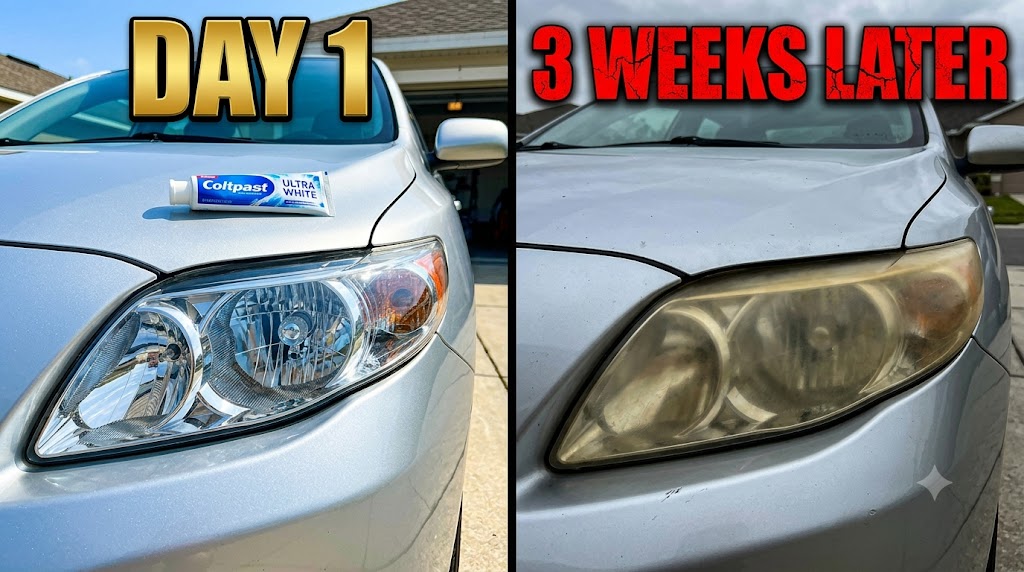
The video is always the same: a pair of yellowed, foggy headlights, a dab of plain white toothpaste (never gel) rubbed in with a cloth, and two minutes later the lens "looks brand new." It's one of the most shared car care hacks on TikTok and YouTube — and here's the tricky part: it actually works. Just not the way the video wants you to believe.
That yellow haze on your headlights is oxidation of the polycarbonate lens, caused by UV rays from the sun. Toothpaste contains a mild abrasive — the same reason it cleans teeth — and that abrasive sands away a thin layer of the oxidized surface, exposing the "fresh" plastic underneath. That's why the immediate result looks so impressive.
The problem: a clear lens with zero protection left
Headlight lenses leave the factory with a UV-protective clear coat. When you sand that surface with toothpaste — even a mild abrasive — you also strip away whatever was left of that protection. The bare plastic you just exposed is now more vulnerable to sunlight than it was before. That's why the haze usually comes back within a few weeks, often worse than when you started. If you live somewhere with brutal summer sun — Texas, Arizona, Florida — it comes back even faster.
What toothpaste can't do
What actually fixes it for good
The correct process uses the same principle — remove the oxidized layer — but with a proper polishing compound, and most importantly, it finishes with a UV sealant or ceramic coating made for headlights. That final step is the one almost everyone skips, and it's the difference between results that last months (or years) and results that die in three weeks. A basic headlight restoration kit with a UV sealant costs $15–25 at any auto parts store, and the whole job takes under an hour.
The rule of thumb from anyone who details cars for a living: anything that removes oxidation must be followed by something that blocks UV. Sand, polish, seal. Skip the last step and you're just renting a clear headlight, not owning one.
Free tool: Tire Size Calculator
Thinking about new wheels or tires? Compare any two tire sizes and see the real difference in diameter, speedometer error, and fitment — instantly.
Open the calculator →