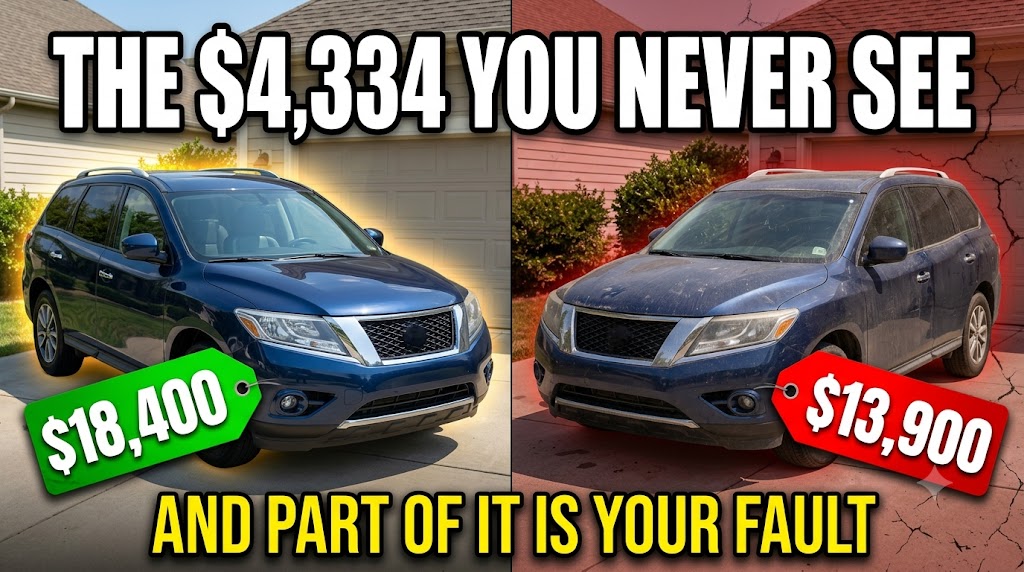
Americans shop hard for gas prices and re-quote their insurance every year. Meanwhile the biggest cost of owning a car goes almost completely unwatched, because it never shows up as a bill. AAA's 2025 Your Driving Costs study put the total annual cost of a new vehicle at $11,577, and the single largest line item in that number is not fuel, not insurance, and not repairs. It's depreciation, at $4,334 a year.
Some of that is unavoidable. A car gets older and accumulates miles, and no amount of care stops the clock. But a meaningful slice of it is self-inflicted, and that's the part worth paying attention to, because it's the only part you control.
The baseline: what a normal car loses
An iSeeCars analysis of more than 950,000 five-year-old used cars sold between March 2025 and February 2026 found average five-year depreciation of 41.8%. The spread by category is wide: trucks held up best at 34.2%, hybrids landed at 35.4%, and electric vehicles took the worst hit at 57.2%.
That's your starting line. Everything below is the damage you stack on top of it.
What actually destroys resale value
Why condition punches above its weight
Appraisers and private buyers both make their first judgment in about thirty seconds, long before anyone opens the hood or pulls the history report. That judgment is almost entirely visual, and it anchors everything that follows. A car that presents as cared-for gets the benefit of the doubt on everything a buyer can't verify. A car that presents as neglected gets the opposite.
This is the reason a weekend of proper detailing before selling routinely returns several times what it costs. You're not just cleaning the car. You're changing which mental category the buyer files it into.
The one that surprises people
Color is the item most owners never think about, and it's decided permanently on the day you buy. If you're choosing between two trims and one comes in a color the market rewards, that decision is worth thousands of dollars five years out. It costs nothing extra to factor in at purchase time and is impossible to fix afterward.
Everything else on this list is still open. Keep the interior clean and smoke-free, keep the paint protected, keep every receipt, and avoid the small collision claims that put a permanent mark on the history report. None of that reverses the $4,334 a year. It just stops you from voluntarily adding to it.
Free tool: Detailing Price Calculator
See what a full detail costs at a shop for your vehicle size, and how much you'd save doing it yourself before you sell.
Open the calculator →